
Introduction
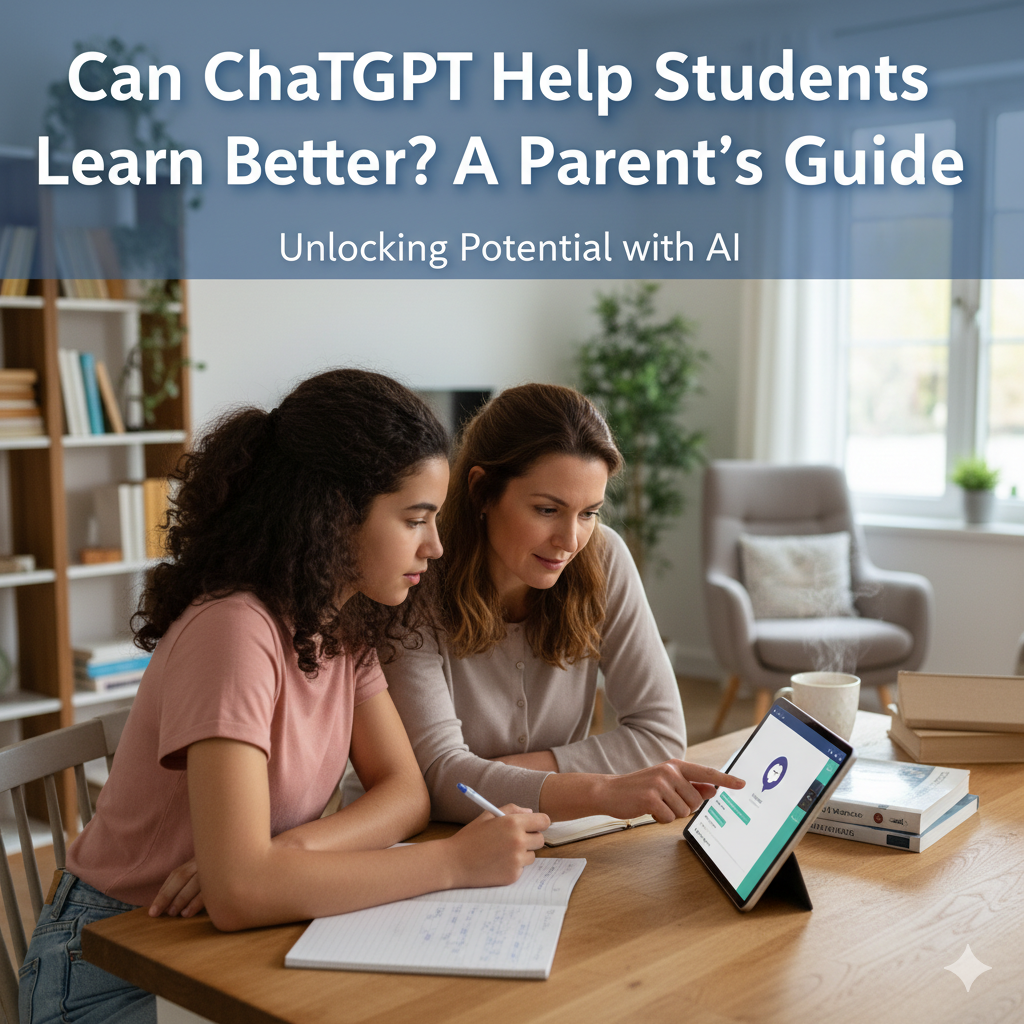
Artificial Intelligence (AI) has quickly moved from science fiction to the study desk. Among the many tools leading this change, ChatGPT stands out as a powerful assistant for both students and educators. But as a parent, you may wonder — Is this tool actually helping my child learn, or making them dependent?
This guide helps you understand how ChatGPT can be used wisely — turning it into a study companion that builds understanding, creativity, and curiosity rather than replacing real effort.
What Is ChatGPT in Simple Terms?
ChatGPT is an AI chatbot developed by OpenAI that can answer questions, write essays, summarize text, explain difficult topics, and even generate creative ideas.
Think of it as a digital tutor — available 24/7, patient, and capable of explaining things in different ways until your child understands.
It’s not magic, though. Its power depends on how you use it — good prompts lead to great learning; lazy ones lead to copy-paste answers.
Ways ChatGPT Can Help Students Learn Better
🧠 1. Explaining Difficult Concepts
Students can ask ChatGPT to explain complex topics in simple language:
“Explain photosynthesis like I’m 10 years old.”
“Help me understand why eclipses happen.”
It helps bridge learning gaps and supports multiple learning speeds.
📝 2. Homework Support, Not Homework Completion
Instead of asking ChatGPT to do homework, students can ask it to check, guide, or explain:
“Can you tell me what’s wrong in this answer?”
“Give me hints to solve this math problem.”
This builds problem-solving skills while keeping integrity intact.
💡 3. Creative Writing and Thinking
ChatGPT is great for brainstorming:
“Give me ideas for a science fair project about renewable energy.”
“Help me start a short story about space explorers.”
It helps children overcome writer’s block and think creatively.
📚 4. Summarizing and Organizing Notes
High-school students can use ChatGPT to summarize long chapters, create outlines, or quiz themselves:
“Summarize Chapter 3 of my history textbook in bullet points.”
“Create 10 quiz questions from this text.”
This improves revision and time management.
💬 5. Practicing Communication and Language Skills
For language learners, ChatGPT acts like a conversation buddy:
“Talk to me in English about my favorite hobby.”
“Correct my grammar after each sentence.”
This interactive practice boosts vocabulary and confidence.
What ChatGPT Can’t Replace
While ChatGPT is powerful, parents must remember it can’t replace:
- Teacher guidance — emotional and conceptual learning still comes best from humans.
- Critical thinking — students must learn to verify, not just accept answers.
- Ethical learning — honesty and originality still matter more than speed.
Parental Tips for Safe & Effective Use
- 🕒 Set boundaries: 20–30 minutes a day of guided use is enough.
- 👀 Supervise early use: Especially for kids under 13.
- 💬 Teach smart questioning: Encourage open-ended prompts like “Why do you think…” or “Explain how…”.
- 📘 Encourage reflection: After each session, ask what they learned from ChatGPT and what they understood on their own.
- 🔍 Cross-check: Always confirm facts from textbooks or teacher notes.
Examples of Smart Student Prompts
| Purpose | Example Prompt |
|---|---|
| Understanding | “Explain Newton’s laws using examples from everyday life.” |
| Creativity | “Give me ideas for a poem about kindness.” |
| Writing | “Help me improve this paragraph for clarity.” |
| Revision | “Ask me 5 quiz questions about World War II.” |
Conclusion
ChatGPT can be a wonderful study partner — when guided with intention.
Used responsibly, it builds curiosity, creativity, and confidence. Used carelessly, it can lead to over-reliance and shallow learning.
For parents, the goal is to teach children to think with AI, not through AI — a life skill that will matter more than any exam.